Update on Warneford Park development

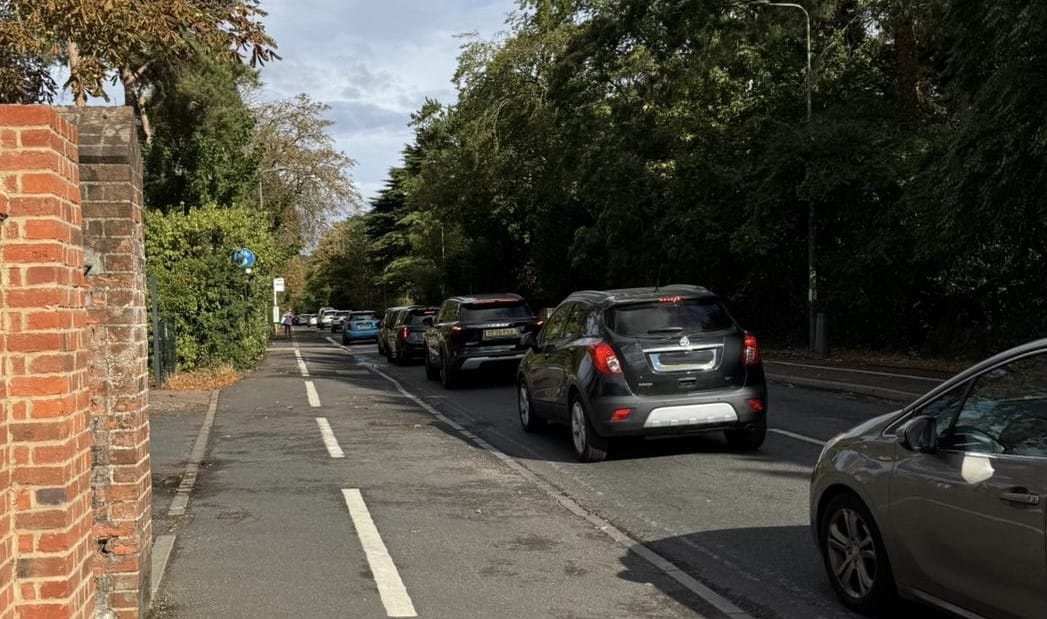
In this post we’re sharing a few updates following on from our August post warning that the proposed Warneford Park development will add hundreds of car trips into Headington.
Who benefits from the additional parking?
In our previous post we speculated that the main purpose of the additional car parking is to lure potential private sector tenants to lease space in the new research centre. We now know this to be true.
In a meeting between Headington Liveable Streets and a representative of the developer team, we asked who was pushing for the additional car parking spaces – is it Oxford University, Oxford Health NHS Foundation Trust or another party? It turns out that their property consultants have advised them that they need to provide on-site car parking in order to attract private sector renters.
This seems like poor advice based on outdated, car-centric thinking that ignores important local context and influences. Perhaps the consultants are projecting their own preference to drive to work onto everyone else?
Have they considered, for example, that potential new staff might:
- value being able to cycle or walk to work, so they can have a cheap, healthy commute?
- want to commute by bus or train to avoid the stress of driving and make better use of that valuable commuting time?
- want to work for an employer that cares about its impact on the environment and local community?
- choose to be car-free for ethical reasons?
- not be able to drive due to disability or poverty?
It’s a given that property consultants’ advice prioritises maximising return on investment and revenue yields for their clients. It disregards negative effects that their clients’ resulting actions will impose on the environment, public health and community wellbeing, following the aged capitalist model: privatisation of benefits; socialisation of costs.
We don’t think it needs to be this way. The developers have chosen a financial model that depends on commercial tenants being part of the site’s make-up, but we don’t agree that attracting commercial tenants depends on providing their workers with on-site car parking.
And if these potential tenants do demand car parking, despite the harm it will inflict on the local community, do we really want those organisations in Headington?
It’s disappointing that Oxford University – which claims to champion sustainability and Vision Zero – didn’t challenge this advice, and that the health trust – who we might expect to care about the physical and mental harm caused by cars – is just going along with it.
Instead, it seems Oxford University is willing to increase pollution, congestion and road danger in Headington because it believes – based on dubious advice from property consultants – that private companies won’t rent space in its new research centre unless their staff can park their cars onsite.
To be clear: these additional parking spaces aren’t for hospital staff or patients, who may have transport challenges due to shift working or illness. They are for the relatively better-paid staff of private sector companies, who are likely to work standard hours with hybrid working options. This will result in a two-tier system, whereby private sector staff will be able to drive to work, regardless of any objective need, but their public sector peers won’t.
County Council breaching its own policy... again
Neither the original Transport Assessment nor the updated version explains the need to provide car parking for private sector research staff. Whilst it refers to particular needs of hospital staff, e.g. “residual demand for travel by car, largely led by the needs of the Trust and shift working and NHS staff demographic needs” and “supports essential NHS operational requirements and shift working,” there’s no explanation of why research staff would need to drive to work.
Yet despite this lack of justification, the County Council’s Transport Development Management Team has approved the additional car parking spaces, even though it clearly conflicts with Council policies, most obviously those to remove 25% of car journeys and reduce and restrict car parking availability.
Councillor Andrew Gant, Cabinet Member for Transport Management, recently rejected proposals to add car parking in East Oxford and Headington, saying “Increasing car parking increases cars, and that is against our policy.” So why is a Council team green-lighting parking that will create 100s of extra car trips in Headington every day?
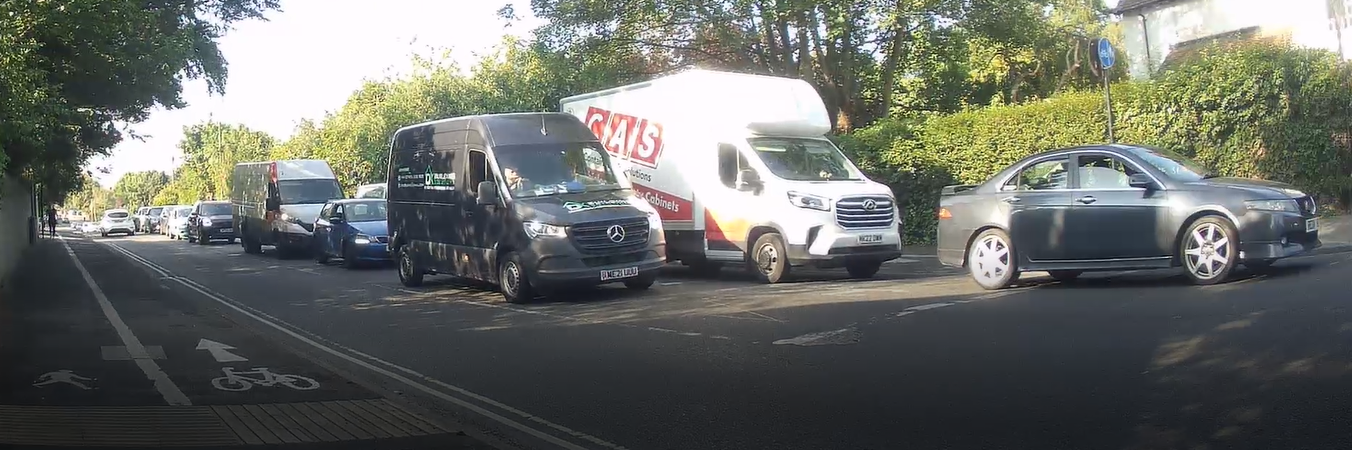
Don't worry, electric cars will save us
The developer representative argued that the increase in cars journeys in Headington won’t be a problem because more cars will be electric and less polluting by the time the new development is built. But this ignores many crucial points:
- Electric cars only eliminate tailpipe emissions – they still produce harmful particulate matter from tyres, breaks and roads. They aren’t “zero-emission”.
- Many Warneford Park staff may not earn enough to buy electric cars, which are still unaffordable for many people.
- Electric cars don’t reduce congestion or road danger.
- It will only be possible to rebuild local roads and junctions to make them safe for cyclists and pavement users and efficient for bus journeys if the volume of private motor traffic is reduced significantly from what it is now. Any increase in cars, whether electric, hybrid, petrol or diesel, will prevent these desperately-needed changes from happening.
Community responses and concerns
Many people have voiced their opinions on the planning application, which can be viewed here. Most of the comments object to the application, and most objections cite the parking as a reason. But even the objecting comments, including ours, are clear in their support for improved hospital and research facilities at Warneford Park.
Our submission focused on the harm the extra cars will cause, particularly to vulnerable groups including children, the elderly and patients.
All the local councillor submissions have objected due to the parking, as well as other reasons, including Chris Smowton, Liz Brighouse, Emma Garnett and Susanna Pressel.
Some supporting comments assert that the harm that will be inflicted on people in Headington as a result of increased car journeys is a price worth paying for having better hospital and research facilities. We’d suggest this is a skewed moral judgment, based on a flawed assumption that it’s not possible to have the improved facilities without the additional car parking.
BBOWT submitted a comprehensive response from a nature-preservation angle, objecting to the increased parking due to the damaging impact of the basement car park and extra pollution from the resulting additional traffic on the vulnerable hydrology, species and ecosystem of the Lye Valley fen. Their comments bring home that what harms us, harms nature, and vice-versa.
Some good news is that there have been some valuable improvements to the designs for the junction and roads around Warneford Park, with the developer adopting many of the features contained in alternative designs commissioned by Oxfordshire Liveable Streets.

Housing workers: a missed opportunity
Interestingly, the previous 2017 proposal included key worker housing, but this is absent from the current plan. In contrast, developments at Osney and Oxpens will provide both housing and employment, recognising the need for affordable housing alongside job creation. Why isn’t the same being required for this major site in Headington?
Given the dire imbalance between jobs and housing in Oxford, why are we letting developers build workspaces without also providing housing?
The developer argues that the housing has been replaced with the graduate college, but these are not equivalent: onsite housing for staff would prevent many car journeys by enabling staff to walk to work, whereas the college will generate more traffic from staff, students, visitors and contractors travelling to it.
The plans for the college also include seven parking spaces for the student family units in the college, which is a violation of Local Plan Policy M3: since the college is inside a Controlled Parking Zone, on a regular bus route, and about 500 metres from the Co-op food store on the Brookes Campus, any housing must be car-free.
Our petition
Nearly 440 people have signed our petition opposing the increase in parking. If you’d like to add your name, you can access it here.
How you can help
There is a very real risk that the planning application will be approved with the parking increase, despite the high level of objections from local residents, councillors and groups. After all, this is what happened c.10 years ago when Oxford University built the Old Road Campus. The university has a track record of winning these fights.
To make your voice heard, as well as signing our petition, you could email the relevant people to let them know how you feel. We’ve included some suggested addressees and content below, which you can use/adapt as you see fit:
To:
Decision-makers (Oxford City Council Planning Committee):
cllrmclarkson@oxford.gov.uk
cllrlfouweather@oxford.gov.uk
cllrmaltaf-khan@oxford.gov.uk
cllrdhenwood@oxford.gov.uk
cllrahollingsworth@oxford.gov.uk
cllrjhunt@oxford.gov.uk
cllrdregisford@oxford.gov.uk
cllrarailton@oxford.gov.uk
cllrlupton@oxford.gov.uk
cllrarehman@oxford.gov.uk
cllrekerr@oxford.gov.uk
Developers:
WarnefordPark@oxfordhealth.nhs.uk
sustainability@admin.ox.ac.uk
news.office@admin.ox.ac.uk
Local Councillors:
cllrmaltaf-khan@oxford.gov.uk (City, Headington)
cllrcsmowton@oxford.gov.uk (City, Headington)
cllrsbrown@oxford.gov.uk (City, Churchill)
cllrmlygo@oxford.gov.uk (City, Churchill)
cllrnchapman@oxford.gov.uk (City, Headington Hill and Northway)
cllrjtaylor@oxford.gov.uk (City, Headington Hill and Northway)
cllrcmunkonge@oxford.gov.uk (City, Quarry & Risinghurst)
cllrrozsmith@oxford.gov.uk (City, Quarry & Risinghurst)
cllrjhunt@oxford.gov.uk (City, St Clement's)
cllrapowell@oxford.gov.uk (City, St Clement's)
liz.brighouse@oxfordshire.gov.uk (County, Churchill & Lye Valley)
roz.smith@oxfordshire.gov.uk (County, Headington & Quarry)
glynis.phillips@oxfordshire.gov.uk (County, Barton, Sandhills & Risinghurst)
andrew.gant@oxfordshire.gov.uk (County, Cabinet Member for Transport Management)
Subject: Objection to increase in parking at Warneford Park
Content:
Dear decision-makers and councillors
I am emailing to object to the increase in the number of car parking spaces that is proposed as part of the Warneford Park development.
The Warneford Park development should instead aim for a 25% reduction from the current amount of car parking space on the site in line with Oxfordshire County Council’s Local Transport and Connectivity Plan target to replace or remove 1 out of every 4 current car trips in Oxfordshire by 2030.
Headington already suffers from harmful levels of congestion, pollution and danger from cars and can't take any further increases in traffic volume.
If the proposed development is not viable without the proposed amount of car parking, then Headington is the wrong location for it.
The developers of Warneford Park must be prohibited from increasing the amount of car parking on the site. They should instead be made to fund fast, cheap, high-quality bus shuttle services from all the Park & Ride sites to Warneford Park for use by staff, patients and visitors.
Kind regards
[Your name]